After assessing the needs and desires of my community, it became apparent that what we need is a solid foundation in herbalism. Establishing that foundation has been keeping me busy, and it's not yet finished, but I am thrilled to present our community project:
This
is no ordinary garden. Appalachia
possesses natural gifts unique to its geographic area. This garden is intended to teach and to
delight. The garden will fulfill a
twofold purpose. First, this project
will educate the community about the local wealth that thrives around the
inhabitants of West Virginia. Instead of
harvesting fruits and vegetables, this garden will serve to teach our children about
identification, cultivation, conservation, and use of Appalachian medicinal plants. Many of the
plants around us possess natural therapeutic properties. People see these plants each
day and write them off as weeds. The Labyrinth will inspire appreciation for our surroundings. Children
from neighboring counties are creating signs to indicate both the
common and scientific name of each plant in the garden.
I hope that everybody is enjoying their summer as much as I
am.I’d like to continue enjoying this summer’s
exuberance, but I've taken a moment for this blog post because there's something that I've been needing to share.
Monroe County, WV
This summer, from here in West Virginia, I’ve been traveling to Ohio,
Virginia, D.C., and Maryland, connecting dots between people and plants and I’ve
never been more content.The substance I've found is that plants are much
more evolved than we may ever be, so check it out:
Honey locust tree, Rutland, Ohio.
Do not fail to notice the thorns on this puppy.
If you’d like to be happier, let a plant draw you in.
Fountainhead Regional Park, Fairfax, VA
Take care of it, or if it's wild, just visit with it and let it be. Sharpen your senses and notice its activity. Then take the time to notice what it’s giving
back to you.
Share your observations with the person next to you, and
life is beautiful.
Buddha's hand,
United States National Arboretum, Washington, D.C.
My hope is that others will find what I’ve found to be true.I hope others are able to use this truth to
transform their heavy, worldly problems into innocuous distractions.Life is too short to not marvel at the terrestrial
magnificence.
MUIH Garden, Laurel, MD
Until next time, whenever that may be, be open, and have a great summer.
While searching for suitable botanicals for a loved one, I stumbled upon Damiana (Turnera diffusa). Naturally,
I developed a fascination with damiana’s many applications. It is used as a tonic,
stimulant, mild laxative, diuretic, antidepressant,
testosterogenic, aphrodisiac; and hypochondriastic
(Chevallier, 2000; Grieve, 2015).
Indeed, many have reported that it is impossible to be unhappy while sipping on a cup of damiana tea. I've luxuriated in many a cup of damiana tea myself, but the following recipe for a damiana cordial really seized my heed. It binds the flavors of damiana and cherry. Hmm... This is sure to be a delectable union.
"Enough of the balmy verbiage," you say?
Magnificent.
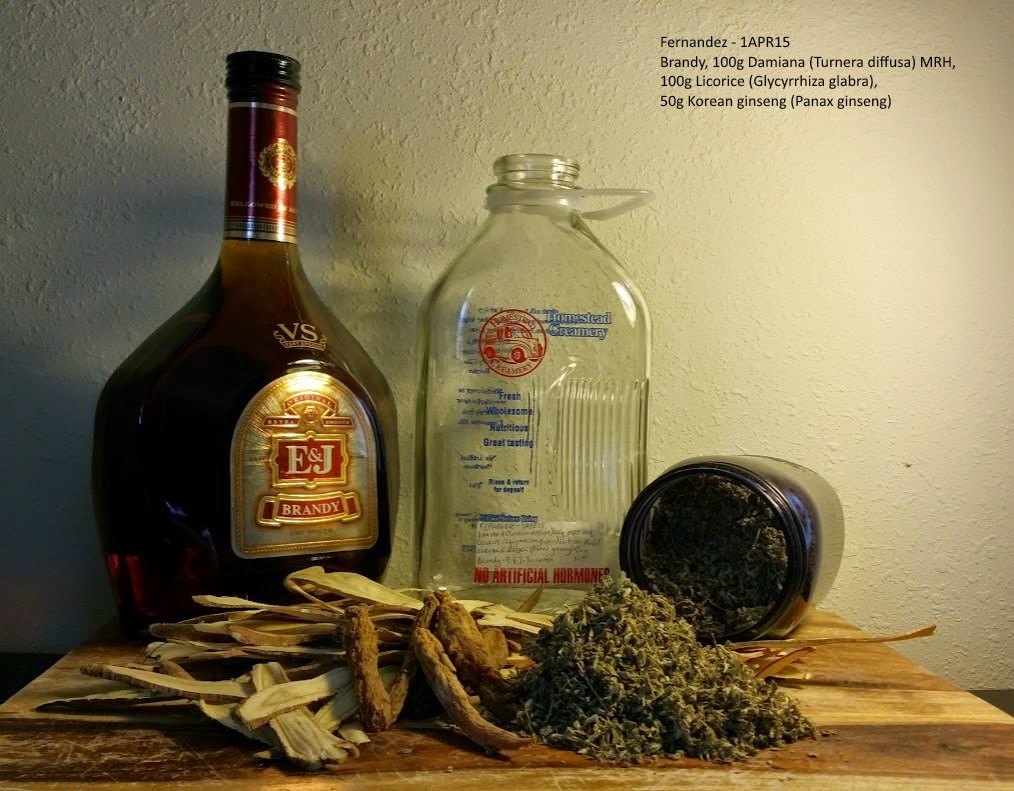
This recipe calls for the following:
25g Asian ginseng (Panax ginseng)
50g Licorice root (Glycyrrhiza glabra)
50g Dried damiana leaves (Turnera diffusa)
Brandy
Black cherry concentrate
Honey to taste
(Database:RegionalBusinessNews, 2010).
Because my purpose of preparing this concoction is to celebrate with friends, I doubled the amounts in my preparation.
I have yet to acquire the black cherry concentrate, so it is not
included in the photo.
A word about combining "extras" with solvents: In this case, the brandy is the solvent. The brandy will extract active, beneficial constituents from the licorice, ginseng and damiana for easy access as a formulated beverage. If one were to saturate a solvent with flavors such as cherry concentrate or honey before maceration, it would diminish the extraction power of the solvent. *At this point, one should note that making tinctures from flavored vodka will not yield potent results.*
I
will not need the black cherry concentrate or the honey until after the
damiana, licorice, and ginseng have macerated in the brandy for at
least seven weeks.
The Korean ginseng in the picture is in whole root form. To prepare
these roots for optimal extraction, I had to increase the surface area of the root
available to the brandy. This means I had to slice it, but trying to process dry roots with a knife is a futile objective.
To surmount this dilemma, the roots were steamed for about twenty
minutes, sliced, then dried again. Then the Korean ginseng, licorice,
and damiana were placed into the maceration vessel, covered with brandy,
and left in the dark to macerate. I shake the vessel daily. I might sample the amalgamation after seven weeks, but I just might
let it macerate until it comes time to celebrate.
After straining, I will
add honey to taste, and for each 250ml liquid, I will add 125ml black cherry concentrate. Then, for decorative
purposes, I imagine I will add some new licorice slices and whole ginseng root to the bottle as well. After
all, this formula is meant to be love-heightening, and I think that the
appearance of a cordial with roots in it adds a little extra something
for the senses.
Camaraderie shared is one of the truest and greatest advantages of a cordial, and it scorches my heart that not
everybody can enjoy alcohol. For some, religious practice may prohibit
the use of alcohol; others are intolerant and/or battle addiction.
Other physical conditions such as pregnancy inhibit the use of alcohol,
and age can also play a factor. In our culture, it is illegal to
consume alcohol before reaching the ripened, judicious, wise age of 21...
Restrictions aside, I think that alcoholic beverages can be good
for the mind, body and spirit. How lovely it is that liquor can be further
enhanced with a little bit of herbal love!
And I couldn't end this post without offering one final glimpse of
the cordial's backside, which with its macerating ginseng, is a beauty
to behold.
Chevallier, A. (2000). Encyclopedia of Herbal Medicine. London: Dorling Kindersley.
Database:RegionalBusinessNews. (2010, 6 1). Make Your Own Medicine: Low Libido. Daily Mail, p. 48.
Grieve. (2015). Damiana. Retrieved from Botanical.com: A Modern Herbal: http://www.botanical.com/botanical/mgmh/d/damian05.html
As I wrapped up my second semester with Maryland University of Integrative Health, I found it appropriate to propose a toast to good times ahead - botanical medicine style. That is, I prepared a larger than usual quantity of a specialty cordial to be enjoyed with some helpful friends when it comes time to celebrate. Before I get down to the recipe, I'd like to take a moment to reflect on what inspired me to make this.
In my last post, I noted that there is much to be thankful for. After that, the gifts kept on coming. I took a trip out to my campus at Maryland University of Integrative Health, where I put in my first hours interning at the Herbal Dispensary and the Medicinal Garden.
The dispensary is where practicing alumni turn to fill botanical prescriptions for their clients. Everything in the dispensary has to be kept clean. Spoons used to scoop out material from one vessel must not enter another vessel. Everything must be measured. When one vessel is emptied, the start date of the next vessel must be recorded for tracking purposes.
During clinic hours, usual tasks are accelerated due to the high level of practitioners ordering multiple formulas simultaneously. This means that in addition to the aforementioned tasks, preparation materials are launched into an incessant rotation. Use. Clean. Rinse. Sanitize. Dry. Repeat. This might sound mundane, but there are legions of wisdom to collect through the experience. One thing I learned from performing multiple dispensary tasks is that rubbing alcohol is exceptional at cleaning up counter-top oil spills! But let us not embark on how I learned this.
The part I most look forward to as I continue with this internship is learning more about how the dispensary is run, to include practicing Good Manufacturing Procedures (GMP) and keeping track of all the plant material - where it comes from and where it goes. I'm not gonna lie though, the best part of this experience has been coming in contact with the different formulations. Reading the scripts of America's practicing clinical herbalists and preparing their formulations is most inspirational.
While I was in Laurel, I also put in some time interning at the Medicinal Garden. Here is a picture from outside the gate:
At the time this photo was taken, there wasn't much to see yet. But we're just getting started.
See this truckload of mulch?
Between three people and two wheelbarrows, we set out to move the truckload from the parking lot down to the garden in two days.
Nothing glamorous, for sure, but we had a damn good time doing it!
The wind was bitter cold that day.
We worked hard...
... and when it came time for a break, we made little couches and enjoyed the warmth of the lively mass.
That's me with Jen Swartout, MA., MS; ISci Faculty; MUIH
And this is Rohan Jasani, Herbal Medicine practitioner and MUIH medicinal garden Gardenmaster.
Every hard worker deserves a good rest.
He's taking some time to enjoy the comforts of a wheelbarrow.
After a long, rewarding day of work, there she rested, split in two, waiting to enter the garden.
Yes ladies and gentlemen, we conquered that pile in one day.
And my, my, my, if this weren't enough awesomeness in one trip...
I had plans to meet up with Helen Metzman, who tends the Jim Duke garden. Helen was so kind and gracious. After chatting as she ushered me around the muddy pathways of the famous medicinal garden, she offered me the opportunity to help around this year when I make my trips to Maryland! Help them. It is the least I can do in exchange for learning at the Jim Duke garden.
Then, I ended up meeting the famous medicine man himself.
If you don't know who Jim Duke is, check out this video:
I was surprised to find that we had a few things in common; there was never a dull moment. Jim Duke is a Class A gentleman. He is also a musician and a veteran. After talking for a while, Jim, Helen, and I went upstairs for some Nettle soup. Just - what a great time! I can't wait to go back!
I returned to West Virginia with a brimming sense of potential for my community. I think I'll continue reaching out to the community with what I've gleaned from my time at MUIH. So far, the people of West Virginia have been warm and responsive to embrace botanical medicine as a new part of their lives. We have everything here in Appalachia, and we can use it to our benefit in a loving and sustainable way.
One phenomenon that stands out to me is the camaraderie that I've seen manifest time and again around botanical medicine. One classmate said to me, "I think reconnecting to our planet, whether by using her bounty to heal
and feed us or by simply trying to treat her with more respect, helps us
to connect to each other." She makes a great point; still I feel like there's another element that I've not yet been able to articulate.
As I reflected on the present and envisaged great things that are sure come, I decided to make this Damiana cordial; because sometime soon there will be a time to celebrate a special realization with a special people here in southern West Virginia. When that time comes, I'll be ready, and so will my tasty beverage.
Oh darn... this post is already so long. I'll write more about this cordial next time - and I'll include the recipe!